Teach

What’s your teaching style?

No two teachers are created the same!

This is so true, as any experienced trainer will tell you. Having to deal with a wide variety of personalities, potentials and idiosyncrasies is what makes the teaching field so challenging … and fascinating! Still, quite early on in a teaching career, a teacher decides what their professional persona is; how they perceive themselves and how they wish to be perceived in class. What I have listed below is a list of very wide categories most teachers fall under, but it is by no means exclusive or scientifically proven!!! It is simply based on my empirical observations. I call them teaching styles, and are to be taken with a grain of salt.

  • Chirpy and cheerful
  • Serious professional
  • Creative maverick
  • Quiet and supportive
  • Traditional and effective

But what makes a teacher opt for one specific style, other than personal preferences of course? Could there be some common denominators between all these different options, shaping those choices to a certain degree?

Well, you must have heard the term rapport being tossed around in relation to teacher training, to refer to the way you approach and engage learners during the lesson. It is often paired with another term, (learner) motivation – hardly surprising, since these two feed off each other! What is more interesting is how these terms are being interpreted according to the wider educational and teacher training contexts. I believe that the way you interpret these terms largely defines your teaching style, and I have composed a quiz to prove it!

So, what is your teaching style? Take the quiz here and find out!

Choose THE ONE answer that BEST summarises your approach to teaching and learning in each area:

A.  Learning philosophy

  • Every learner is different, and a teacher needs to take that into account and be flexible.
  • Syllabuses are there for a reason and they must be followed for a successful outcome.
  • Learners should be allowed to express themselves at all times.
  • There should be little or no homework: most of the learning should be done in class.
  • If learners are not motivated, there is very little you can teach them.

B.   Control over learners

  • The teacher should follow the lesson plan no matter what.
  • Learners can learn a lot when given freedom of choice.
  • The teacher should be in control at all times.
  • The teacher should act as a facilitator most of the time.
  • Learners’ attention will fail if left to their own devices.

C. Teacher talk

  • The teacher should speak loudly to draw the learners’ attention.
  • Learners don’t need to be told what to do in detail the whole time.
  • Learners should talk more than the teacher.
  • Repetition is always helpful.
  • Proper terminology should be used at all times.

D. Overall demeanour

  • The teacher should be cheerful at all times.
  • The teacher should be serious and avoid smiling.
  • Teachers should keep a distance from learners so as to preserve their authority.
  • The teacher’s pastoral role is critical.
  • Teachers should treat learners like equals.
E. Attitude to correction and feedback
  • Learners should be allowed to make mistakes as it facilitates learning.
  • Teachers should correct all the mistakes learners make, at some point.
  • Teachers can choose which mistakes they should correct and when.
  • Learners should not be asked to correct themselves or each other: it is the teacher’s job.
  • Teachers should never make mistakes in their language: it makes them look unprofessional.

F. Preparation and planning

  • Each lesson should be planned in detail.
  • It is usually enough to have a quick look at the coursebook pages you are teaching and have an answer key at hand.
  • We should never use designated coursebooks: we can ask learners what they want to do in each lesson and go from there.
  • You can find materials online and prepare a quick task or two, if needed.
  • It is important that you have a clear idea of where your lesson is going, but you also need to be prepared to make changes on the fly.

I do hope you’ve enjoyed this! Were you the type you thought you would be? Please drop a line in the comments.

Learn

I do not understand my CELTA grade!

First of all, Happy 2024 everyone!

We’re starting off the New Year with a post prompted by a very common phenomenon, in my experience: trainees are often at a loss when it comes to how their performance is assessed and what grade they should be able to achieve, based on their performance on the course.

This results in two broad categories of misconceptions, depending on the trainees’ personality, the amount of explicit feedback they get on the course and, of course, their rapport with their tutors.

Category 1: I can’t get it right, no matter what I do

Photo by Andrea Piacquadio on Pexels.com

These trainees constantly underestimate themselves, are in fear of failing the course and refuse to stop worrying about it, even in the face of very positive feedback from the course tutors. This is not as rare as you might think, especially when it comes to trainees being perfectionists and/or high achievers, either by character or by necessity. This is not uncommon in a labour market that has become very competitive and increasingly insecure! People think they have to be perfect in order to secure a decent teaching position.

Category 2: I deserved a better grade

Photo by Liza Summer on Pexels.com

This is admittedly a larger category, as many tutors can testify! These trainees may have a very high opinion of their teaching skills and language expertise. This is not necessarily unjustified, nor is it solely due to their being over-confident by nature. Some trainees may have achieved high academic grades or have even excelled in a variety of teaching environments, although normally this would entail courses that are either academically focused or traditionally very T-centred, or both. Other trainees may have little teaching experience and cannot understand what is needed in order to pass the course; I have even encountered candidates who believed that paying the course fees automatically ensured their passing.

So, what do you do?

Both of these seemingly very different types of trainees have two things in common:

  • They can both feel very demotivated and disappointed throughout the course. This is a very real hurdle in their development, as they either try too hard or not enough in some cases. It may also have a negative impact on the other trainees on the course, if there is a constant climate of confusion and uncertainty.
  • They have not been given clear, explicit feedback as to what the course grading criteria are and how they translate in their individual cases, other than the standard CELTA5 page.

Needless to say, in both cases, it can be useful to clarify the grading criteria during individual tutorials, so that trainees have a clearer picture of where they stand and what they need to do in order to pass the course or achieve a higher grade.

This is post is targeted at current or future CELTA trainees, who enter the course with certain expectations regarding their performance and the grade they should achieve. I would use it during individual tutorials throughout the course to help raise trainee awareness as to how the grading criteria meet their course expectations. In that sense, it may be helpful to tutors as well! So here it is.

In the following table, I’ve tried to break down the performance descriptors - the grading criteria, in simple English – set by Cambridge into more digestible bits by using simpler, trainee-friendly language.

Is this table crystal clear? Probably not!

Is it clearer than the relevant page on the CELTA 5 course record that trainees receive?

I should say yes!

Does it raise trainee awareness of what they need to achieve in order to get the desired grade? In my experience, again yes!

So, if you are/were a trainee, would this table give you a clear idea as to what is needed for a higher grade?

As a trainer, would you find this useful?

As usual, please let me know what you think in the comments , and feel free to offer suggestions for improvement.

Teach

Using your voice and presence in class

This post kicks off our Back-to-Basics series, focusing mainly on – you guessed it – basic classroom techniques! The idea for this series came to me as I frequently had to train pre-service teachers, who had a practical need for core techniques that would help them function in a classroom environment with some efficiency.

Most beginner training courses do not spend much time on these techniques, either for reasons of expediency or because they are taken for granted. Still, many trainees have never been in a classroom setting before, and the fact that many training courses involve online teaching (and a set of additional basic skills) does not make things any easier.

Each individual trainee has their own teaching style, and this is based a lot on what kind of teacher presence they may project. Some teachers may be quiet and low-key, others may be louder and enthusiastic, or laid-back and subtle – the list can go on. It usually takes some time to decide what your teaching style is and what image you want to project to your learners, usually based on your personal traits and preferences. Many teachers harbour under the misconception that they should be a specific type of teacher in order to be effective, which can be quite an obstacle to development.

Nevertheless, there is one thing most teachers have in common: they have a selection of common basic tools at their disposal, and this is their starting point. The way each teacher decides to use these tools is what defines their teaching style.  Let’s have a look at these tools one by one.

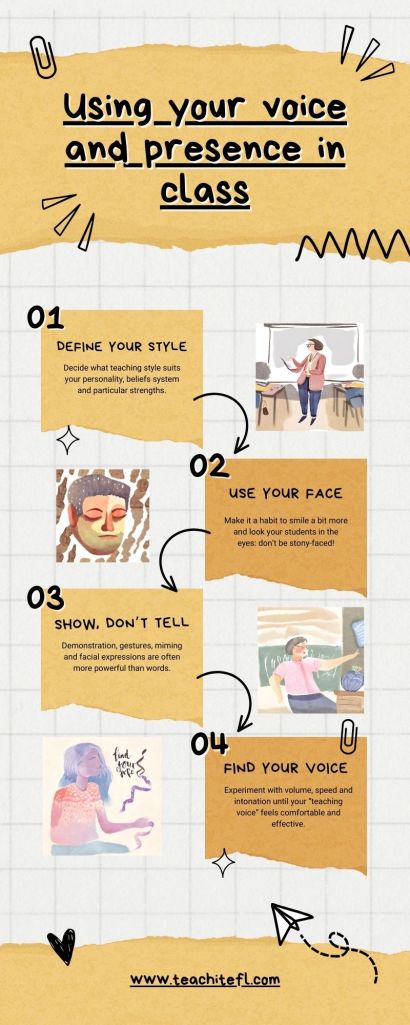
This includes eye-contact, smiling and using facial expressions to convey feelings and meaning. Some teachers are not very comfortable with facial expressions or are by nature shy and not very expressive: that’s OK. Teachers do not have to be performers! However, there are a couple of things that everyone can do and are usually quite helpful in creating a positive classroom atmosphere.

AI generated Image by rawpixel.
  • Look at your learners – not at the floor, the ceiling, the wall, or the board the whole time. Try and establish eye-contact with them, especially the ones that are trying to say something or answer a question. This shows you’re actively paying attention to them, you acknowledge their presence and respect their efforts and contributions. This may also prove a bit more challenging for shy, introverted teachers, but it is definitely worth a try!!!
  • Remember to smile a few times during the lesson, especially when you are making eye-contact. This immediately makes eye-contact more friendly, and less threatening or awkward – in most cultures at least. In general, smiling at learners can make you look more approachable, creating a less impersonal teaching atmosphere. It can work wonders for encouraging and engaging learners.
  • Using facial expressions instead of words, when possible: this can be more helpful in clarifying meaning at times, which brings us to our next point.

Most people automatically resort to words when trying to communicate, give an example or explain. This is fine in everyday life, but you’ll need more than that, for example, in a multilingual classroom where English is the only language common to all. So, here’s what your options are:

  • Using facial expressions, e.g., to show you don’t understand, to praise, to encourage a learner to continue, even to demonstrate meaning, like in adjectives describing feelings.
  • Using gestures to do most of the above, plus to clarify instructions or to check understanding.
  • Demonstrating how something is done rather than trying to explain it verbally.
  • Miming an action or series of actions, to clarify meaning or give instructions.

Obviously, your voice is one of your main tools and what you say in class (and what you don’t say!) is very important. Here, however, we are going to talk about how you can use your voice so that:

  1. You do not find you’re losing your voice at the end of a long teaching day.
  2. You do not feel like you’ve been talking a lot but what you say falls on deaf ears, which is extremely frustrating!
  3. You can maximize learner attention and involvement.

The following tips are based on common sense and classroom experience.

  • Find your teaching voice: avoid using a loud, high-pitched voice, in the hope of drawing attention. Instead, experiment until you find the right register for you: carrying, but comfortable to use over long periods of time without tiring your vocal cords.  A good rule of thumb is that your voice should easily carry to learners sitting at the back of the room, under normal circumstances.
  • Regulate your speed of delivery: speaking too fast can create miscommunication, while speaking too slowly can have a hypnotic quality! Aim at speaking at a normal, average speed.
  • Vary your intonation.   A monotonous voice, even if one is shouting, rarely holds attention. Using a friendly, conversational tone of voice, with all the natural ups and downs, can make a difference even during a long explanation slot. A low, monotonous, “lecture” voice on the other hand can ensure lapses of attention every time!
  • Finally, for those fortunate enough to teach YL classes, try whispering instead of shouting: when you whisper, the automatic reaction is to quiet down in order to hear you! This can often work with rambunctious learners 😊
Image by rawpixel

Please, leave your own tips in the comments below, as well as questions, suggestions, or a simple hello!

Images by Freepik and Rawpixel.

Infographic created in Canva

Learn, Teach

My tutor doesn’t like me and that impacts on my assessment!

Once you have enough enough training courses under your belt, you are bound to have heard this complaint, probably more than once. It is one of the most common ones, coming from trainees who have difficulty accepting feedback. There can be many reasons why this is so, but in this post I’d like to focus on a very specific one: the tutor changeover, usually half-way through the course.

Image by pch.vector on Freepik

Many thanks to Julie Lhnr and Diana Vaselenko for inspiring this post with their questionnaire on Swapping Tutors.

It is a common requirement on most training courses that trainees should work with at least two different tutors for many different reasons, the obvious one being to reduce the chances of complaints as the one above. One can think of many other benefits of this arrangement, which I am not going to list here; let us just mention a major one: experiencing different teaching and training styles.

But just swapping tutors mid-course is not enough. There are several other procedures that have to be in place in order to ensure the changeover has a positive impact on the overall quality of the course, and of course this involves not only course tutors but also the school administration as well. The following points are addressed to both.

No school can really afford to turn away trainees these days, but you can at least be prepared for what it’s going to take to keep difficult trainees from ruining a whole course. During the interview part of the process:

  • Prepare a careful list of questions, aimed at receiving feedback and working with others, so that you can spot potential problems early on, as much as possible.
  • Let tutors know from the start which trainees may need careful handling: DO NOT let them walk into the course blindly!
  • Make it very clear during the interview, and preferably in writing as well, that there will be a tutor change and that it is a course requirement. Also, explain in no uncertain words, that it is an assessment criterion whether trainees take feedback into account.

It’s not enough to clarify from the start what the procedures are, why tutors have to swap and what this means. This level of transparency has to be kept up throughout the course:

  • Share pre-course tasks and all assignment and TP feedback reports in a common folder, accessible to all course tutors.
  • Encourage tutors to go back to each other’s notes when facing claims like “the other tutor had asked me to do the opposite!”
  • Do not hesitate to quote specific feedback given by other course tutors, mentioning the specific TP/assignment it was given: make it objective – not personal!

Tutors should keep tabs on each other as much as possible. Of course, it is up to each separate school’s procedures and each tutor’s willingness to go the extra mile, but it can be extremely helpful with diffusing potentially difficult situations.

At this point, I’d like to make something very clear: tutors are NOT obliged to spend extra time liaising with each other, usually without any remuneration, trying to troubleshoot various situations. It is also the school’s responsibility to make the tutor’s work easier, since it is for their mutual benefit. I am well-aware that this is not always the case and I am not trying to guilt already overworked and probably underpaid tutors into investing even more of their time and effort into their work. The points suggested below should be relatively painless and easy to implement, always at the tutors’ discretion.

  • Spend 10 minutes looking at the latest TP feedback before you go into an input delivery or assisted lesson planning session; you can then be prepared for potentially disappointed, over-confident or even aggressive trainee attitudes: you’ll know what probably prompted this and therefore you may be able to do something about it.
  • Hold a brief 15-minute meeting with the other course tutors once a week, just to check what is going on and who might need extra help. Chances are you can identify weaker trainees who will need extra support, compare trainee attitudes towards different tutors, and generally present a united front, making sure you maintain consistency in feedback and support.
  • Do not hesitate to ask the other tutors for advice on how to handle difficult situations, checking how they would normally handle it or what the school procedures are in such situations. If there is an official complaint made, you may be the last to find this out, so make sure you have let everybody know a specific trainee is having a difficult time, how exactly this happened and what you’re planning to do / you have done about it. Take special care to let the school admin know about potential problems as soon as you’re sure what is happening: they should appreciate your professionalism. It does come back to transparency.

This is a no-brainer, but may not be feasible in all circumstances. Of course, you will have a higher incidence of trainee complaints such as the above, if the trainees have never met the second course tutor before the transition. This would mean they’d spent all their time on the first half of the course with one tutor, for better or for worse, getting used to a specific way of doing things and will resist change anyway, especially when feeling stressed and insecure.

What can you do then? Depending on how much leeway you have, you may try one or more of the following suggestions:

  • Make sure you can share as many input sessions as possible between tutors; include a couple of shared sessions if possible.
  • Share assignment marking among tutors, double-marking as many papers as possible.
  • Make no secret of the fact that tutors compare notes on the trainees’ work and follow everybody’s progress closely.
  • Capitalise on the fact that each tutor may have a different way to approach certain aspects of teaching, and therefore has different tricks to show the trainees. (Keep fingers crossed you don’t hit a wall of trainees saying “I want to learn the one correct way”).

What will ultimately seal the deal though is taking the trouble to be on the same page as the other tutor, regarding the following:

  • Starting sessions on time
  • Delivering feedback on the same day, e.g. within 24-hours of the TP
  • Being as detailed in your feedback as you feel you need
  • Delivering teaching materials and TP points at the pre-agreed time, at least 48 hours before the corresponding SLP session.
  • Returning assignments on the pre-agreed date
  • Strike the right balance between being flexible and observing course rules

If you are consistent with the above throughout the course, it will take a very negative trainee to claim they were treated differently in the second part of the course. Hopefully!

Let me close this post by a rather obvious observation. Yes, there will always be trainees who will come up with this sort of complaint, no matter what you do to avoid it. The steps suggested above are not fool-proof: they’re just ways to preempt and diffuse such situations. None of them can hold a candle to a really negative, defensive, determined-to-complain-about everything, none-of-this-is-my fault attitude which – fortunately only a few – trainees may bring to a course.

For those cases, I feel for you… If you’d like a post about how we may deal with these trainees, let me know in the comments below.

Images by Freepik

Teach

Inside the listener’s head – part 1

I have to admit this is a bit of a misleading title, since no-one else has access to the listener’s head but themselves! Still, it is our job as teachers to try and guess what is going on in there, using research findings based on empirical data to help us.

I want to give a bit of historical background, not because I want to show off my wealth of knowledge – and, incidentally, bore you to death – but because I have seen that certain old-fashioned beliefs still hold sway in both learners’ and teachers’ attitudes towards classroom listening practice.

Most of you have heard of “bottom-up” and “top-down” processing, concepts that attempt to picture what is happening inside the listener’s head and draw useful conclusions for classroom practice. Many of the teachers I’ve come across over the years still struggle with understanding these concepts. This can be because, despite the many diagrams used, it is not very clear what that vertical direction refers to: up/down towards what exactly? From a general idea to specific information? From the phoneme to the whole text? From using lower to using higher thinking skills?

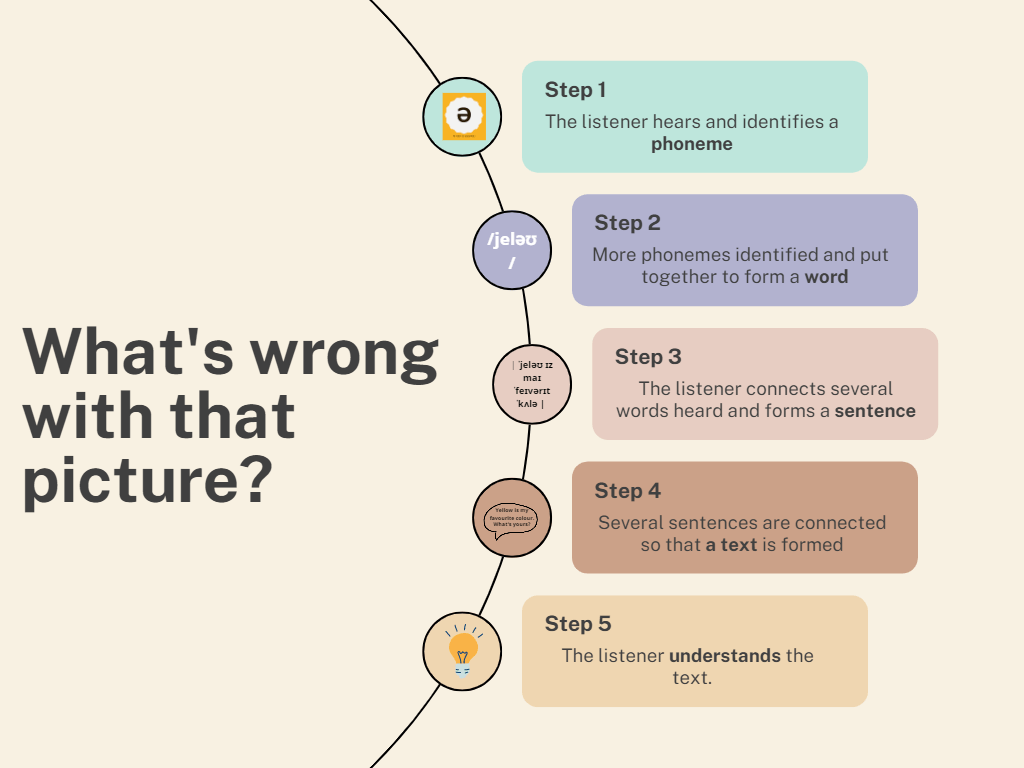
I believe that a linear representation does not necessarily serve better understanding of the listening process. I’ll now proceed, rather cheekily, with two different diagrams: one representing the more old-fashioned serial view of the listening process and another showing a more complex picture of what is happening inside the listener’s head. I’ll call them the line and the circle.

THE LINE

This view believes that the listener processes what they hear starting from the smallest chunk of sound, then adding them together to form words, which are then added to form sentences and eventually leads to the understanding of the whole text. We do not need all the empirical data of studies conducted with both L1 and L2 listeners, young and adult, beginner and advanced ones, to realise that if this were true, it would take the listener forever to decipher the speaker’s message, let alone formulate an appropriate response. Nevertheless, teachers still use recorded texts, paused and replayed ad nauseum, trying to get learners to understand every little thing they hear, all the time believing they are actually helping their learners develop their listening skills.

Unfortunately, this encourages the learners’ natural tendency to begin with processing the smallest amount of information and thus avoid information overload. Of course, this leads to some rather frustrating listening habits, like relying on the repetition of the information many times (never happening in real life listening) and the learners’ need to understand EVERYTHING before they can feel they’ve understood what the text is about (simply not true!).

Most importantly, it demotivates learners since it is an unrealistic and extremely demanding task. All this focus on detail encourages the segmentation of information, not regarding the text as a whole but as unrelated little chunks and relying solely on the acoustic input to decipher the message. No wonder learner confidence is shattered and motivation plummets!

We’ll contrast this with the circle in our next post.

I think you can guess my question for you now:

Have you found yourself following the line model, consciously or not, in your listening lessons?

 I’m the first to admit that I have and that I have also found it extremely difficult to retrain learners to focus on other sources of information and regard the text as a whole.

Looking forward to your comments!

Alexandra