Teach

Inside the listener’s head – part 1

I have to admit this is a bit of a misleading title, since no-one else has access to the listener’s head but themselves! Still, it is our job as teachers to try and guess what is going on in there, using research findings based on empirical data to help us.

I want to give a bit of historical background, not because I want to show off my wealth of knowledge – and, incidentally, bore you to death – but because I have seen that certain old-fashioned beliefs still hold sway in both learners’ and teachers’ attitudes towards classroom listening practice.

Most of you have heard of “bottom-up” and “top-down” processing, concepts that attempt to picture what is happening inside the listener’s head and draw useful conclusions for classroom practice. Many of the teachers I’ve come across over the years still struggle with understanding these concepts. This can be because, despite the many diagrams used, it is not very clear what that vertical direction refers to: up/down towards what exactly? From a general idea to specific information? From the phoneme to the whole text? From using lower to using higher thinking skills?

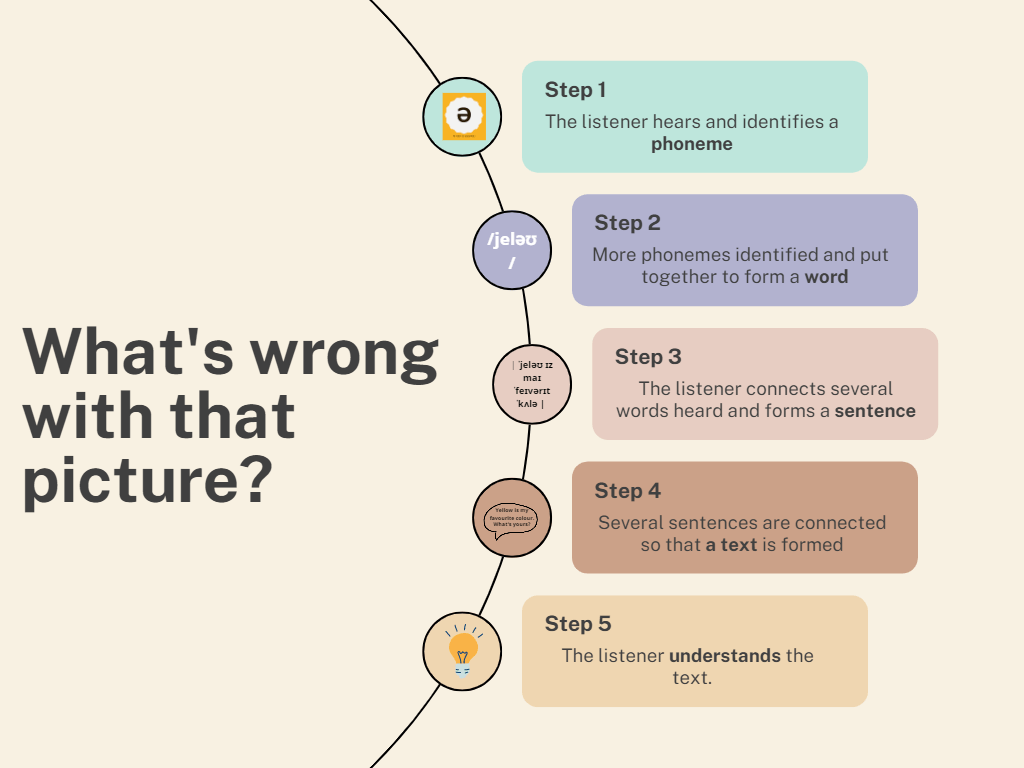
I believe that a linear representation does not necessarily serve better understanding of the listening process. I’ll now proceed, rather cheekily, with two different diagrams: one representing the more old-fashioned serial view of the listening process and another showing a more complex picture of what is happening inside the listener’s head. I’ll call them the line and the circle.

THE LINE

This view believes that the listener processes what they hear starting from the smallest chunk of sound, then adding them together to form words, which are then added to form sentences and eventually leads to the understanding of the whole text. We do not need all the empirical data of studies conducted with both L1 and L2 listeners, young and adult, beginner and advanced ones, to realise that if this were true, it would take the listener forever to decipher the speaker’s message, let alone formulate an appropriate response. Nevertheless, teachers still use recorded texts, paused and replayed ad nauseum, trying to get learners to understand every little thing they hear, all the time believing they are actually helping their learners develop their listening skills.

Unfortunately, this encourages the learners’ natural tendency to begin with processing the smallest amount of information and thus avoid information overload. Of course, this leads to some rather frustrating listening habits, like relying on the repetition of the information many times (never happening in real life listening) and the learners’ need to understand EVERYTHING before they can feel they’ve understood what the text is about (simply not true!).

Most importantly, it demotivates learners since it is an unrealistic and extremely demanding task. All this focus on detail encourages the segmentation of information, not regarding the text as a whole but as unrelated little chunks and relying solely on the acoustic input to decipher the message. No wonder learner confidence is shattered and motivation plummets!

We’ll contrast this with the circle in our next post.

I think you can guess my question for you now:

Have you found yourself following the line model, consciously or not, in your listening lessons?

 I’m the first to admit that I have and that I have also found it extremely difficult to retrain learners to focus on other sources of information and regard the text as a whole.

Looking forward to your comments!

Alexandra

Opinions

In English, please!

Should we use the learners’ native language in class?  

That is quite a common question, usually in the form of whether this is a “good” or a “bad” thing to do in class. Although this is not how I would approach this matter, since practically nothing in EFL is black or white, I do see the value of discussing this from the point of view of best practices.

This is what I’ll try to cover:

  • How this debate started, in the light of learning theories and methods
  • How the issue has evolved since then: changes in the teaching/learning environment over the years
  • How using L1 or L2 can become a power tool
  • Whether there are any benefits in using L1 and at which points in the lesson
  • What problems can arise from the use of L1 and why

So, if you were looking for a quick answer, you are not in the right place 😊

In the beginning, there was the Direct Method.

Back in the late 1800s – early 1900s, this method was developed in Europe, in a response to the Grammar-Translation Method that dominated classrooms until then. The Direct Method (or Natural Method) banished the use of L1 in the classroom, insisting that translation has no place in language learning.  More specifically: [1]

  • The teacher only spoke in L2.
  • Only everyday vocabulary and phrases were taught.
  • Both speech and listening comprehension were taught.
  • Grammar was taught inductively: the learners had to work out the rules for themselves.
  • New teaching points were introduced orally.
  • Oral communication skills were practised through carefully constructed teacher-student question and answer exchanges, e.g., Where is the cat? It is behind the box.
  • Correct pronunciation (where correct means native-speaker accent) and grammar were emphasised.
  • Vocabulary was taught either through realia (concrete objects) or elicitation: never through translation.

The Direct Method played a key role in elevating native speakers as “better” teachers than non-native speakers: an attitude that still prevails in many parts of the world nowadays. More about that in another post, if you like 😉

But this is 2022!

A lot has changed since the Direct Method was first introduced, and later replaced by other approaches focusing more on vocabulary, grammar and reading, such as situational language teaching, the audiolingual approach, and communicative language teaching, to name but a few that followed.

  • Classes have become increasingly multilingual, especially international on-line classes. Technological advances made on-line multilingual classes possible, and COVID forced millions into online communication and learning. There is no common L1 to rely on and use in class.
  • Society has changed and “correct” RP accents are no longer the norm. Other varieties of English have become acceptable and are being taught around the world.
  • Learners have more practical expectations from their lessons: the focus has shifted from sounding British/ American to being able to communicate successfully, even with mistakes. Let’s not forget that globalisation and huge immigration issues have merged populations and cultures that had previously come into little contact with each other. As a result, English has become a lingua franca for millions who use it for survival reasons: basic communication skills are at the forefront.
  • The present exam-obsessed situation in many language schools (a result of an exam-obsessed educational culture in many countries) has delegated speaking to one of the 4 or 5 exam papers. More emphasis is given to correct grammar and vocabulary, which can help learners succeed in an exam and can be explained in L1 if possible and necessary.
  • Also, let us not forget that a lot of English phrases are now used as part of young people’s everyday language, as a result of English-speaking culture becoming prevalent all over the world, from Greece to Korea. This blurs the lines between L1 and L2, making an already complex situation even more complicated.
  • Finally, more and more teachers are getting trained and have realised that teaching is not about speaking the language with an impressive accent: it is rather about having the skills and the craftmanship needed to negotiate the modern language classroom successfully.

I could go on but I’m trying my best to be brief (not my forte!)  

Are we all the same?

This question may seem strange to some but it touches on a very sensitive issue: the balance of power in a class. What I am going to describe now is perhaps more pertinent to a class of young learners or teenagers, rather than in an adult learner class, but still quite common in many learning contexts.

It is considered natural that teachers are de facto in a position of superiority over the learners, and that they are assigned more power over the learning process.  As a result, teachers are given more freedom of choice as to what should (not) be said in class.  Even if they resort to L1 in their explanations, they may still expect the learners to use L2 at all times. Needless to say, this does not really make sense and can create some awkward situations like:

  • The learners perceive this as an injustice and “defy” the teacher by using what is expressly forbidden, the L1, giving rise to a variety of discipline problems.
  • The learners do not have the linguistic resources to use L2 at all times, and as a result they feel frustrated and ineffectual.
  • At the hands of certain teachers, forbidding learners to use L1 in the classroom is another weapon in their arsenal, enabling them to exert more power over their learners and control the learning process.

Needless to say, such situations are not conducive to learning.

At this point, I’ll have to come to a halt as this post is getting too long.  If you want to find out whether I think it is actually bad for learners to use L1 in class, please follow me into Part 2 😊


[1] Source: Approaches and Methods in Language Teaching, Richards and Rodgers, CUP

Teach

WHAT LISTENING IS AND WHAT IT IS NOT

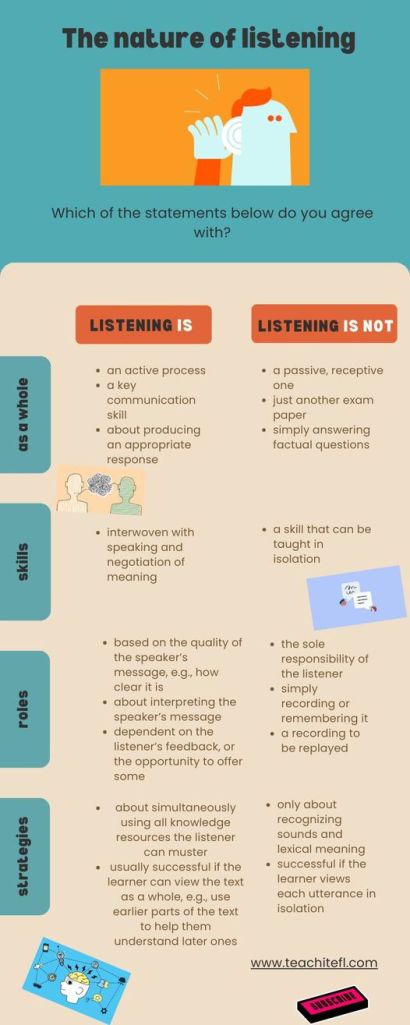
There is a general impression that listening is a “neglected” skill, that it has received less attention than its more famous siblings, reading and speaking. Although research (e.g., Rost, 2002) has been focusing more and more on the key role of listening in language learning, I still feel that we as teachers may not fully appreciate the pivotal role it plays in both developing other language skills and in actually learning a new language. More to the point, I believe it is difficult to realise exactly how difficult and how complex the listening process is for our students. This is why I’m starting this listening series.

Rather predictably, I’m starting with a look at the nature of the listening process.

To wrap up, I have a simple task for the reader: just go down the checklist above and tick the points that reflect your own beliefs about listening. And if you feel like sharing, please put down your top 3 in the Comments section below.

Looking forward to reading your comments!

Welcome

And here we go!

Happy to finally get this started! [1]

This blog is dedicated to my many trainees, former and future, and to all of the hard-working teachers I know, who still believe teaching is a force for change in today’s society!

I’ve been toying with the idea of starting a blog for a long time, but every time something else came up and I found myself absorbed in other work. Until COVID, I did not have either the time or the energy to really get down to it. I started writing a couple of blog posts and then I let it fizzle away, finding a good many reasons why I could not keep it up, why I would not find the time to maintain the blog – let alone writing new posts, etc.

When COVID happened, we were all forced to hit the brakes and take a hard look at what we’ve been doing, whether we liked it or not. Luckily for me, this coincided with the end of a very hectic period in my work life, which involved long hours, intensive work and high levels of stress (if this reminds you of a teacher’s typical working life, it was!). So, I just had to listen to the quiet and could not avoid re-evaluating my priorities.

Since I was forced, like everyone, to do with much less (company, freedom, stimuli, security), I began to see what actually mattered to me much more clearly and easily. I always knew that, apart from feeling some sense of financial security,  I was not in this field for material rewards or prestige. I always felt happiest when I was able to contribute to a team, support and nurture, help others see their potential and connect to people.  I know that many of you feel the same about teaching and understand what I mean. And I decided to connect with you in this way.

This is not to say that exposing myself to the blogosphere came easy to me. I do not have an exaggerated opinion of myself or my abilities. I know what I can offer and what I cannot, and I also know that I feel passionate about many things in our profession, and I wanted to share this passion. I expect that some people may not agree with my opinions or may not find my content useful. But I’ve happily reached the stage in my life at which I no longer care. This blog is for people who approach teaching in a positive mindset, targeted towards growth. It is not a blog about haters of any of the many shortcomings we all face in our field. So, this is what to expect here:

  • Practical ideas about teaching materials and using tech tools
  • Tips and suggestions on how to approach your training and professional development
  • Methodology content, based on interactive posts (more about that later)
  • Passionate opinions strongly held – although still strictly personal!

Those of you who know me personally, and many of you do, also know that I am talkative, enthusiastic, and genuinely interested in everything new in our field. Therefore, no fear of running out of content! But what is more important is that I’m not starting this blog simply in order to hear my own voice reverberating in the blogosphere! I’m actually interested in reaching out to you and connecting with you. This is why all my blog posts will finish with questions for you, and I really do hope you take the time and drop a few lines in the comments, responding to these questions.

So, let’s get this tradition started:

  1. What would you like to see in this blog? Which of the above areas interest you the most?
  2. How has COVID changed your working life, especially in relation to online teaching (but not only)?

[1] (Yes, I know I used a split infinitive: please don’t tell Sheldon!)