I'm Alexandra and I'm a CELTA and DELTA trainer. I've been a teacher trainer for over 10 years now, doing both online and face-to-face courses, while working with hundreds of trainees both locally and internationally. My background in teaching makes my training style practically oriented, and I enjoy designing my own materials and sharing classroom tips. I've been passionate about teaching for most of my life and I hope I can share this with you.
This is so true, as any experienced trainer will tell you. Having to deal with a wide variety of personalities, potentials and idiosyncrasies is what makes the teaching field so challenging … and fascinating! Still, quite early on in a teaching career, a teacher decides what their professional persona is; how they perceive themselves and how they wish to be perceived in class. What I have listed below is a list of very wide categories most teachers fall under, but it is by no means exclusive or scientifically proven!!! It is simply based on my empirical observations. I call them teaching styles, and are to be taken with a grain of salt.
TEACHING STYLES
Chirpy and cheerful
Serious professional
Creative maverick
Quiet and supportive
Traditional and effective
But what makes a teacher opt for one specific style, other than personal preferences of course? Could there be some common denominators between all these different options, shaping those choices to a certain degree?
Well, you must have heard the term rapport being tossed around in relation to teacher training, to refer to the way you approach and engage learners during the lesson. It is often paired with another term, (learner) motivation – hardly surprising, since these two feed off each other! What is more interesting is how these terms are being interpreted according to the wider educational and teacher training contexts. I believe that the way you interpret these terms largely defines your teaching style, and I have composed a quiz to prove it!
So, what is your teaching style? Take the quiz here and find out!
QUIZ
Choose THE ONE answer that BEST summarises your approach to teaching and learning in each area:
A. Learning philosophy
Every learner is different, and a teacher needs to take that into account and be flexible.
Syllabuses are there for a reason and they must be followed for a successful outcome.
Learners should be allowed to express themselves at all times.
There should be little or no homework: most of the learning should be done in class.
If learners are not motivated, there is very little you can teach them.
B. Control over learners
The teacher should follow the lesson plan no matter what.
Learners can learn a lot when given freedom of choice.
The teacher should be in control at all times.
The teacher should act as a facilitator most of the time.
Learners’ attention will fail if left to their own devices.
C. Teacher talk
The teacher should speak loudly to draw the learners’ attention.
Learners don’t need to be told what to do in detail the whole time.
Learners should talk more than the teacher.
Repetition is always helpful.
Proper terminology should be used at all times.
D. Overall demeanour
The teacher should be cheerful at all times.
The teacher should be serious and avoid smiling.
Teachers should keep a distance from learners so as to preserve their authority.
The teacher’s pastoral role is critical.
Teachers should treat learners like equals.
E. Attitude to correction and feedback
Learners should be allowed to make mistakes as it facilitates learning.
Teachers should correct all the mistakes learners make, at some point.
Teachers can choose which mistakes they should correct and when.
Learners should not be asked to correct themselves or each other: it is the teacher’s job.
Teachers should never make mistakes in their language: it makes them look unprofessional.
F. Preparation and planning
Each lesson should be planned in detail.
It is usually enough to have a quick look at the coursebook pages you are teaching and have an answer key at hand.
We should never use designated coursebooks: we can ask learners what they want to do in each lesson and go from there.
You can find materials online and prepare a quick task or two, if needed.
It is important that you have a clear idea of where your lesson is going, but you also need to be prepared to make changes on the fly.
(I very much doubt it with everything that’s going on, but it can’t hurt to wish it, right?)
We’re starting off the New Year with a post prompted by a very common phenomenon, in my experience: trainees are often at a loss when it comes to how their performance is assessed and what grade they should be able to achieve, based on their performance on the course.
This results in two broad categories of misconceptions, depending on the trainees’ personality, the amount of explicit feedback they get on the course and, of course, their rapport with their tutors.
Category 1: I can’t get it right, no matter what I do
These trainees constantly underestimate themselves, are in fear of failing the course and refuse to stop worrying about it, even in the face of very positive feedback from the course tutors. This is not as rare as you might think, especially when it comes to trainees being perfectionists and/or high achievers, either by character or by necessity. This is not uncommon in a labour market that has become very competitive and increasingly insecure! People think they have to be perfect in order to secure a decent teaching position.
This is admittedly a larger category, as many tutors can testify! These trainees may have a very high opinion of their teaching skills and language expertise. This is not necessarily unjustified, nor is it solely due to their being over-confident by nature. Some trainees may have achieved high academic grades or have even excelled in a variety of teaching environments, although normally this would entail courses that are either academically focused or traditionally very T-centred, or both. Other trainees may have little teaching experience and cannot understand what is needed in order to pass the course; I have even encountered candidates who believed that paying the course fees automatically ensured their passing.
So, what do you do?
Both of these seemingly very different types of trainees have two things in common:
They can both feel very demotivated and disappointed throughout the course. This is a very real hurdle in their development, as they either try too hard or not enough in some cases. It may also have a negative impact on the other trainees on the course, if there is a constant climate of confusion and uncertainty.
They have not been given clear, explicit feedback as to what the course grading criteria are and how they translate in their individual cases, other than the standard CELTA5 page.
Needless to say, in both cases, it can be useful to clarify the grading criteria during individual tutorials, so that trainees have a clearer picture of where they stand and what they need to do in order to pass the course or achieve a higher grade.
This is post is targeted at current or future CELTA trainees, who enter the course with certain expectations regarding their performance and the grade they should achieve. I would use it during individual tutorials throughout the course to help raise trainee awareness as to how the grading criteria meet their course expectations. In that sense, it may be helpful to tutors as well! So here it is.
In the following table, I’ve tried to break down the performance descriptors - the grading criteria, in simple English – set by Cambridge into more digestible bits by using simpler, trainee-friendly language.
Is this table crystal clear?Probably not!
Is it clearer than the relevant page on the CELTA 5 course record that trainees receive?
This post kicks off our Back-to-Basics series, focusing mainly on – you guessed it – basic classroom techniques! The idea for this series came to me as I frequently had to train pre-service teachers, who had a practical need for core techniques that would help them function in a classroom environment with some efficiency.
Most beginner training courses do not spend much time on these techniques, either for reasons of expediency or because they are taken for granted. Still, many trainees have never been in a classroom setting before, and the fact that many training courses involve online teaching (and a set of additional basic skills) does not make things any easier.
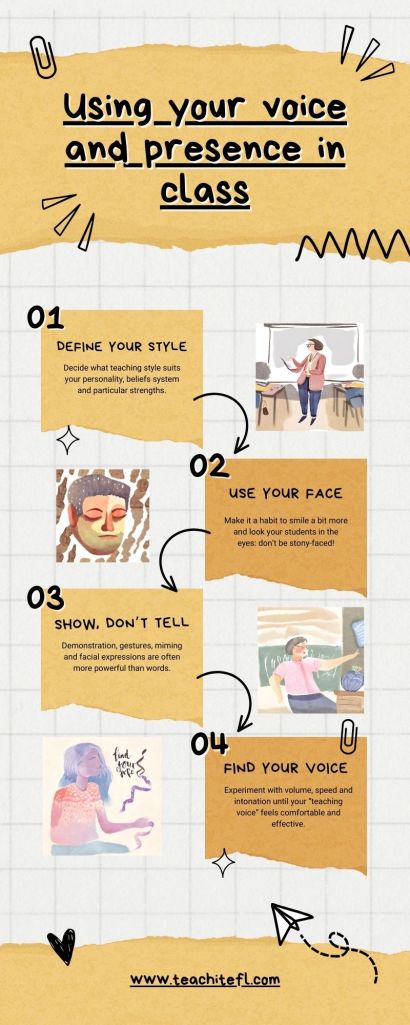
Establishing a teacher presence
Each individual trainee has their own teaching style, and this is based a lot on what kind of teacher presence they may project. Some teachers may be quiet and low-key, others may be louder and enthusiastic, or laid-back and subtle – the list can go on. It usually takes some time to decide what your teaching style is and what image you want to project to your learners, usually based on your personal traits and preferences. Many teachers harbour under the misconception that they should be a specific type of teacher in order to be effective, which can be quite an obstacle to development.
Nevertheless, there is one thing most teachers have in common: they have a selection of common basic tools at their disposal, and this is their starting point. The way each teacher decides to use these tools is what defines their teaching style. Let’s have a look at these tools one by one.
Facialexpressions
This includes eye-contact, smiling and using facial expressions to convey feelings and meaning. Some teachers are not very comfortable with facial expressions or are by nature shy and not very expressive: that’s OK. Teachers do not have to be performers! However, there are a couple of things that everyone can do and are usually quite helpful in creating a positive classroom atmosphere.
AI generated Image by rawpixel.
Look at your learners – not at the floor, the ceiling, the wall, or the board the whole time. Try and establish eye-contact with them, especially the ones that are trying to say something or answer a question. This shows you’re actively paying attention to them, you acknowledge their presence and respect their efforts and contributions. This may also prove a bit more challenging for shy, introverted teachers, but it is definitely worth a try!!!
Remember to smile a few times during the lesson, especially when you are making eye-contact. This immediately makes eye-contact more friendly, and less threatening or awkward – in most cultures at least. In general, smiling at learners can make you look more approachable, creating a less impersonal teaching atmosphere. It can work wonders for encouraging and engaging learners.
Using facial expressions instead of words, when possible: this can be more helpful in clarifying meaning at times, which brings us to our next point.
Show, don’t tell!
Most people automatically resort to words when trying to communicate, give an example or explain. This is fine in everyday life, but you’ll need more than that, for example, in a multilingual classroom where English is the only language common to all. So, here’s what your options are:
Using facial expressions, e.g., to show you don’t understand, to praise, to encourage a learner to continue, even to demonstrate meaning, like in adjectives describing feelings.
Using gestures to do most of the above, plus to clarify instructions or to check understanding.
Demonstrating how something is done rather than trying to explain it verbally.
Miming an action or series of actions, to clarify meaning or give instructions.
Using your voice wisely and effectively
Obviously, your voice is one of your main tools and what you say in class (and what you don’t say!) is very important. Here, however, we are going to talk about how you can use your voice so that:
You do not find you’re losing your voice at the end of a long teaching day.
You do not feel like you’ve been talking a lot but what you say falls on deaf ears, which is extremely frustrating!
You can maximize learner attention and involvement.
The following tips are based on common sense and classroom experience.
Find your teaching voice: avoid using a loud, high-pitched voice, in the hope of drawing attention. Instead, experiment until you find the right register for you: carrying, but comfortable to use over long periods of time without tiring your vocal cords. A good rule of thumb is that your voice should easily carry to learners sitting at the back of the room, under normal circumstances.
Regulate your speed of delivery: speaking too fast can create miscommunication, while speaking too slowly can have a hypnotic quality! Aim at speaking at a normal, average speed.
Vary your intonation. A monotonous voice, even if one is shouting, rarely holds attention. Using a friendly, conversational tone of voice, with all the natural ups and downs, can make a difference even during a long explanation slot. A low, monotonous, “lecture” voice on the other hand can ensure lapses of attention every time!
Finally, for those fortunate enough to teach YL classes, try whispering instead of shouting: when you whisper, the automatic reaction is to quiet down in order to hear you! This can often work with rambunctious learners 😊
Image by rawpixel
Please, leave your own tips in the comments below, as well as questions, suggestions, or a simple hello!
Once you have enough enough training courses under your belt, you are bound to have heard this complaint, probably more than once. It is one of the most common ones, coming from trainees who have difficulty accepting feedback. There can be many reasons why this is so, but in this post I’d like to focus on a very specific one: the tutor changeover, usually half-way through the course.
Many thanks to Julie Lhnr and Diana Vaselenko for inspiring this post with their questionnaire on Swapping Tutors.
It is a common requirement on most training courses that trainees should work with at least two different tutors for many different reasons, the obvious one being to reduce the chances of complaints as the one above. One can think of many other benefits of this arrangement, which I am not going to list here; let us just mention a major one: experiencing different teaching and training styles.
But just swapping tutors mid-course is not enough. There are several other procedures that have to be in place in order to ensure the changeover has a positive impact on the overall quality of the course, and of course this involves not only course tutors but also the school administration as well. The following points are addressed to both.
The selection process
No school can really afford to turn away trainees these days, but you can at least be prepared for what it’s going to take to keep difficult trainees from ruining a whole course. During the interview part of the process:
Prepare a careful list of questions, aimed at receiving feedback and working with others, so that you can spot potential problems early on, as much as possible.
Let tutors know from the start which trainees may need careful handling: DO NOT let them walk into the course blindly!
Make it very clear during the interview, and preferably in writing as well, that there will be a tutor change and that it is a course requirement. Also, explain in no uncertain words, that it is an assessment criterion whether trainees take feedback into account.
Be transparent
It’s not enough to clarify from the start what the procedures are, why tutors have to swap and what this means. This level of transparency has to be kept up throughout the course:
Share pre-course tasks and all assignment and TP feedback reports in a common folder, accessible to all course tutors.
Encourage tutors to go back to each other’s notes when facing claims like “the other tutor had asked me to do the opposite!”
Do not hesitate to quote specific feedback given by other course tutors, mentioning the specific TP/assignment it was given: make it objective – not personal!
Encourage inter-tutor communication
Tutors should keep tabs on each other as much as possible. Of course, it is up to each separate school’s procedures and each tutor’s willingness to go the extra mile, but it can be extremely helpful with diffusing potentially difficult situations.
At this point, I’d like to make something very clear: tutors are NOT obliged to spend extra time liaising with each other, usually without any remuneration, trying to troubleshoot various situations. It is also the school’s responsibility to make the tutor’s work easier, since it is for their mutual benefit. I am well-aware that this is not always the case and I am not trying to guilt already overworked and probably underpaid tutors into investing even more of their time and effort into their work. The points suggested below should be relatively painless and easy to implement, always at the tutors’ discretion.
Spend 10 minutes looking at the latest TP feedback before you go into an input delivery or assisted lesson planning session; you can then be prepared for potentially disappointed, over-confident or even aggressive trainee attitudes: you’ll know what probably prompted this and therefore you may be able to do something about it.
Hold a brief 15-minute meeting with the other course tutors once a week, just to check what is going on and who might need extra help. Chances are you can identify weaker trainees who will need extra support, compare trainee attitudes towards different tutors, and generally present a united front, making sure you maintain consistency in feedback and support.
Do not hesitate to ask the other tutors for advice on how to handle difficult situations, checking how they would normally handle it or what the school procedures are in such situations. If there is an official complaint made, you may be the last to find this out, so make sure you have let everybody know a specific trainee is having a difficult time, how exactly this happened and what you’re planning to do / you have done about it. Take special care to let the school admin know about potential problems as soon as you’re sure what is happening: they should appreciate your professionalism. It does come back to transparency.
Involve all tutors throughout the course
This is a no-brainer, but may not be feasible in all circumstances. Of course, you will have a higher incidence of trainee complaints such as the above, if the trainees have never met the second course tutor before the transition. This would mean they’d spent all their time on the first half of the course with one tutor, for better or for worse, getting used to a specific way of doing things and will resist change anyway, especially when feeling stressed and insecure.
What can you do then? Depending on how much leeway you have, you may try one or more of the following suggestions:
Make sure you can share as many input sessions as possible between tutors; include a couple of shared sessions if possible.
Share assignment marking among tutors, double-marking as many papers as possible.
Make no secret of the fact that tutors compare notes on the trainees’ work and follow everybody’s progress closely.
Capitalise on the fact that each tutor may have a different way to approach certain aspects of teaching, and therefore has different tricks to show the trainees. (Keep fingers crossed you don’t hit a wall of trainees saying “I want to learn the onecorrect way”).
It all boils down to consistency
What will ultimately seal the deal though is taking the trouble to be on the same page as the other tutor, regarding the following:
Starting sessions on time
Delivering feedback on the same day, e.g. within 24-hours of the TP
Being as detailed in your feedback as you feel you need
Delivering teaching materials and TP points at the pre-agreed time, at least 48 hours before the corresponding SLP session.
Returning assignments on the pre-agreed date
Strike the right balance between being flexible and observing course rules
If you are consistent with the above throughout the course, it will take a very negative trainee to claim they were treated differently in the second part of the course. Hopefully!
Final thoughts
Let me close this post by a rather obvious observation. Yes, there will always be trainees who will come up with this sort of complaint, no matter what you do to avoid it. The steps suggested above are not fool-proof: they’re just ways to preempt and diffuse such situations. None of them can hold a candle to a really negative, defensive, determined-to-complain-about everything, none-of-this-is-my fault attitude which – fortunately only a few – trainees may bring to a course.
For those cases, I feel for you… If you’d like a post about how we may deal with these trainees, let me know in the comments below.
DISCLAIMER: I am not a trained SEN educator, psychologist or medical professional. What I am is a very experienced teacher and trainer, and a neuro-diverse person myself. What you will read below describes my personal experience with trainees. Any beliefs, opinions or advice you find below are entirely my own and do not constitute professional guidelines or best practices.
Continuing from the previous post, we are looking at increasingly complex teaching situations and the ensuing problems.
There are several times when one or more trainees ask you to stop and rephrase what you said or start from the beginning, claiming they cannot follow you at all, even if what you are saying seems simple and straightforward.
What happens:
Again, we are not talking about trainees who lack basic knowledge or the linguistic competence to follow a simple argument. And we are not talking about trainees who are simply indifferent or unmotivated and cannot bother to follow what you are saying. We are talking about trainees who are honestly trying very hard to follow you as you explain something, but they cannot remember what you said a minute ago. As a result, they get lost almost immediately, and therefore ask for help. There is nothing wrong with their comprehension skills, again, but their retention and concentration abilities are lacking.
How you see it:
You can see that the requests for repetition and help clearly require attention, but you cannot keep doing that throughout the whole session. A shift of perspective might help here: instead of worrying about how responding to such requests may upset your lesson plan, think of how much more effective your teaching can be if you can involve everyone, even those that need more support.
Ways to handle it:
Clearly, both patience and flexibility are highly required here, but I would like to make a couple of practical suggestions, connected to planning a session and managing a class.
Once you have spotted such trainees in your group, there should be a shift in your materials design: since you cannot do the best for everyone, settle for doing the best you can for most of them. This means you may have to forego ambitious class activities or highly technical sessions, full of terminology (assuming you wanted to do these things in the first place!). You may find yourself unable to go into concepts in much detail, having to confine yourself to the basics, presented in a succinct, accurate manner. You therefore need to plan for shorter, simpler input.
Apart from input quantity and degree of analysis, there should also be a shift in pace and use of alternative modes of instruction. You will need to examine cognitive loads carefully and avoid having dense, demanding activities one after the other. Instead, plan for deliberate pauses during your session, allowing trainees time to note down points or take a screenshot. Insert a recap slide every few slides, when a particular section has been completed. Plan for specific elicitation slots, with lots of clear visuals, following short simple steps and the tri-modal input model: say/ask + do + write. Finish each elicitation slot with a short checking task, e.g., T/F.
You can easily see that the techniques suggested above are time consuming and require a specific approach: instead of cramming as much as possible into your session, assuming more is better, you rather make a conscious choice to move at the pace of your “slower” learners and give everybody a chance to digest information and perhaps come up with some interesting questions.
Again, the suggestions above may not stop some trainees from getting lost at some points during the session, but there are certain benefits:
They will reduce the amount of confusion and the need for repetition in neuro-diverse trainees.
The whole process forces you, the trainer, to re-examine the scope and effectiveness of your materials, and rethink what works and for whom.
All trainees benefit from such an approach, being involved in most stages of the session and avoiding frequent or long explanation slots by the tutor.
The benefits mentioned in the previous point are all present here as well.
During input sessions, you notice specific trainees are always the first to speak when you ask a question, but their contributions are rarely relevant to the question asked. It seems like they just waited for you to stop talking, in order to make an irrelevant point or ask a totally unrelated question themselves.
What happens:
Such trainees always seem very eager to contribute but their contributions are often disruptive and almost never helpful. They are always faster than everyone else and there comes a point when no other trainee gets a chance to say anything, and you start dreading asking questions. They may honestly be trying their best to contribute to the session, and they cannot stop themselves from blurting out a statement, without always realising that it is irrelevant to the point being discussed. What’s more, their statements often lack cohesion or even coherence, and it may be really difficult to understand what they are trying to communicate, let alone answer their queries or decide how they are related to the session in question. In such cases, you may also notice problems with the trainees’ written work, in terms of coherence and cohesion, as well as excessive and often incoherent teacher talk during teaching practice sessions. It seems like the link translating thoughts into coherent speech is not working.
Ways to handle it:
This is very tricky indeed, since one of the most basic means of communication, speech, does not seem to work. Such trainees do not only have a problem comprehending input but are also extremely frustrated when they try to make themselves understood: what makes perfect sense to their ears is met with puzzlement, and gradually annoyance, by everybody else. As a result, they are often defensive, unreceptive to feedback (which they cannot comprehend most of the time), and deeply hurt when they realise that they are perceived as annoying and disruptive by their peers.
There is no simple way to handle this, really. A mix of techniques may prove useful, but only to a certain extent. Here are some that I have tried over the years:
Having one-to-one tutorials with the trainees in question, trying to understand their queries, and explain to them that they should let other trainees speak as well.
Prepare a careful list of T/F statements that reflects your concerns about the trainee’s development and ask them to complete it; then arrange an individual tutorial with them. Careful: your statements should be short and simple, e.g.,
I believe that I work well in a team. T/F
When my trainer asks a question, I always feel I know the answer. T/F
I feel my contributions are clear and helpful. T/F
If I have something to say on a point, I should say it immediately, not wait for someone else’s contributions. T/F
If in an online teaching environment, ask all trainees to mute themselves and nominate specific learners to contribute. A bit authoritarian but works at a pinch.
Be mindful who you’re pairing with the trainees in question during learner-oriented activities: avoid pairing them with weak, easily confused or short-tempered trainees and avoid pairing them with the same trainees all the time. Vary their partners and monitor closely.
Final notes
There are a couple of final points I’d like to make, more in the nature of what NOT to do in such delicate situations.
Well, for one, I would do my very best not to express annoyance at specific trainees, or single them out in any way. This might be extremely difficult to do under certain circumstances, e.g., intensive synchronous on-line courses, but it is crucial if any of the above coping techniques are to succeed.
For another, please do not forget that these trainees find it extremely difficult to cope with the course demands, especially if they do not have the option of going for a part-time course or doing a face-to-face course, which can simplify interaction a lot. On top of that, there may be an extra layer of challenge, if they are not familiar with an online teaching environment: the combination of neurodiversity and technophobia can be truly paralysing for some trainees! You are there to support them, not judge them.
Finally, I would like to highlight the fact that most of these trainees are either unaware of their diagnosis, or ashamed of it. In either case, they will almost invariably fail to mention it in their application forms, which leaves both schools and trainers between a rock and a hard place, since even the meagre affordances given to such trainees in most training schemes cannot be taken advantage of. It is a sad fact that such discriminations exist to the extent that people feel the need to hide anything that may be perceived as a disability, even to the detriment of their own development. But it is a fact. All we can do is cope the best we can and support them to the best of our ability.
DISCLAIMER: I am not a trained SEN educator, psychologist or medical professional. What I am is a very experienced teacher and trainer, and a neuro-diverse person myself. What you will read below describes my personal experience with trainees. Any beliefs, opinions or advice you find below are entirely my own and do not constitute professional guidelines or widely-accepted best practices.
Like most teachers in almost any type of teaching situation have observed, there is an ever-increasing number of neurodiverse learners in our classrooms, apparently many more than there used to be. I myself can say I had at least a couple of them in almost every course I have taught over the past 7 years. I think this can be easily explained if we take into account that:
diagnosis is much easier nowadays, so younger trainees are more likely to be aware of their neuro-diversity,
a large number of older trainees have never been diagnosed and are under the impression that they are merely absent-minded or just easily tired.
Admittedly both teachers and trainers are more aware of possible divergent learner needs and quicker to respond to a learner who seems to struggle concentrating on simple tasks or remembering short instructions. This makes trainers more flexible, which is especially necessary taking into account the one-size-fits-all type of training courses that are the norm nowadays.
Flexibility is an obvious answer to the problem of responding to a variety of learner needs, but I will try to make it more specific by referring specifically to teacher training courses, and more specifically to relevant problems that may occur and how I have dealt with them over the years.
Image by macrovector on Freepik
Before I start, let me preface this by saying that the notion of mixed ability classes is not a new one by far, having been discussed in bibliography for decades[1]. So is the concept of multiple intelligences and the need for varying learner preferences to be taken into account.[2] Some of the techniques used to dealing with such learning contexts are very useful when working with neuro-diverse trainees and we do make use of them, e.g., using multimodal input. Below I have added my own suggestions which are of a practical nature and based on practical observations.
Situation 1: You notice that one or more trainees seem to ask for confirmation repeatedly, even if what you have said seems simple and obvious.
What happens:
We are not talking about trainees who are simply insecure, or stressed, or overwhelmed by the massive input some intensive courses entail. We are talking about trainees who you know have comprehended the input and are able to make use of it, as demonstrated by, e.g., their assignment work. Still, they feel the honest need to double-check almost everything, more than once.
How you see it:
Instead of dismissing such trainees as attention seekers or annoying perfectionists, consider whether they might actually doubt their own abilities for comprehension or are under a strong compulsion to ask for confirmation, even of the simplest thing. They may even be aware of the fact that they are becoming disruptive, but they literally cannot help themselves.
Ways to handle it:
Obviously, you will need a lot of patience with such trainees, since their repeated requests for confirmation can disrupt input sessions. You could consider pre-emptive steps, like asking them to repeat points before they ask you for confirmation, clearly numbering the steps involved and recording them on the board.
Image by Rochak Shukla on Freepik
Example:
Decide if you want to focus on reading or listening.
Find a short text that you would like to use from an intermediate coursebook.
Look at the coursebook activities and decide if you would like to use them.
Alternatively, you could offera short list of T/F questions that check comprehension of the points you just made.
Finally, consider using more visuals and gestures when making a point, and not relying solely on oral verbal cues. What I have found quite effective is a tri-modal approach: say + do/show/ draw + write.
Example:
SAY: Take notes
DO: Mime writing something down on paper
WRITE: 1. Take notes
All the above techniques may not stop the trainee in question from asking for confirmation completely, but they do have the following advantages:
They do stop them half of the time.
They provide some useful recap for the rest of the class.
They involve the whole class, not just the trainees in question.
They provide a written record of what you said, which can be copied and referred to, should the need for confirmation arise.
They deflect focus from the problem itself to the need for clarity of input, which is relevant to every trainee’s needs.
There are a couple more situations I’d like to discuss, but they’ll have to wait for the next blog post, since this one is already quite long.
Please let me know how you handle similar situations yourselves and share your tips in the comment section below.
[1]The Mixed Ability Class by Julia Tice, 1997, Richmond Publishing
[2]Multiple Intelligences in the Classroom 3rd Edition by Thomas Armstrong, 2009, ASGD
This is the second installment of our mind -reading post, attempting to decipher how the listener interprets and manages to respond to the speaker’s message.
What we hope to achieve is to clarify that the whole process is much more complex than the line model may suggest. It is not a series of steps that cumulates in comprehension, but rather a set of factors that interact with each othersimultaneously in forming an interpretation of the message. This is the key characteristic of the circle model.
THE CIRCLE
This should logically result in two conclusions:
Listening is a much more demanding task than merely assembling and collating sounds, therefore not to be underestimated in terms of the challenge it presents for the listener.
The listener is called to play a much more active role than the one traditionally implied by terming listening as a receptive skill, since the listener is the one that combines the various elements available into a coherent interpretation.
Most traditional listening tasks focus on the linguistic elements in the circle, coloured blue here, ignoring all the other resources available to the listener and therefore limiting their capabilities of correctly interpreting the speaker’s message.
Of these additional resources, one group is independent of the listener’s language level: background knowledge and knowledge of language usein discourse (for example, you expect to hear questions in a phone inquiry). These green boxes have to do with our experiences of the world around us as native listeners of our L1. This is a ready-made repository of resources waiting to be activated, contribute to comprehension and help boost the listener’s confidence and motivation.
The lone yellow box, context and co-text, refers to resources that we can make available to our learners before listening begins, drawing their attention to the physical setting where listening takes place, the relationship between the participants, what clues to listen for in the text in order to find information more easily, and so on. By allowing learners enough time to process all these additional resources before the actual listening task, we automatically reduce the information load required of the listener and make the actual listening task much less daunting.
The overall conclusion is that although the line looks much simpler and tidier than the various interlinking elements of the circle, it does not make listening any easier for our learners: on the contrary, it makes it much more demanding and demotivating by denying them some easily-accessible extra help.
We will refer back to these two models in the forthcoming posts, when discussing best practices, types of listening activities as well as the sequence of listening tasks within a lesson. For now, here’s a question for you:
Which of the elements in the circle do you feel you have not used / are not usingenough in your own lessons?
Footnote: Let me be the first to acknowledge that teachers may be bound to syllabuses and coursebooks prescribing to specific methodologies and beliefs, which may make it difficult to adhere to personal teaching principles. We’ve all been there and are required to reconcile the practical with the beneficial. My questions at the end of each post do not aim at getting already overworked and underpaid teachers second-guess their efficiency in class or spend their precious little free time on creating new materials from scratch. My hope is that we can discuss our own beliefs and practices and that we can come up with practical, easily applicable and no-fuss teaching tips to improve our day-to-day teaching, and my firm belief is that what is needed most is a shift in perspective and focus – not fancy, time-consuming materials 😊
Hello again and welcome to the second (and last) part on using the learners’ native language (L1) in class.
Having looked at how and why certain learning theories and approaches had “forbidden” the use of L1 in class, we then examined what the situation looks like in today’s multilingual, often on-line classrooms. We are now going to look at whether it is actually a good idea to use L1 in class, when and how.
Benefits of using L1 in class
(How to use L1 in class)
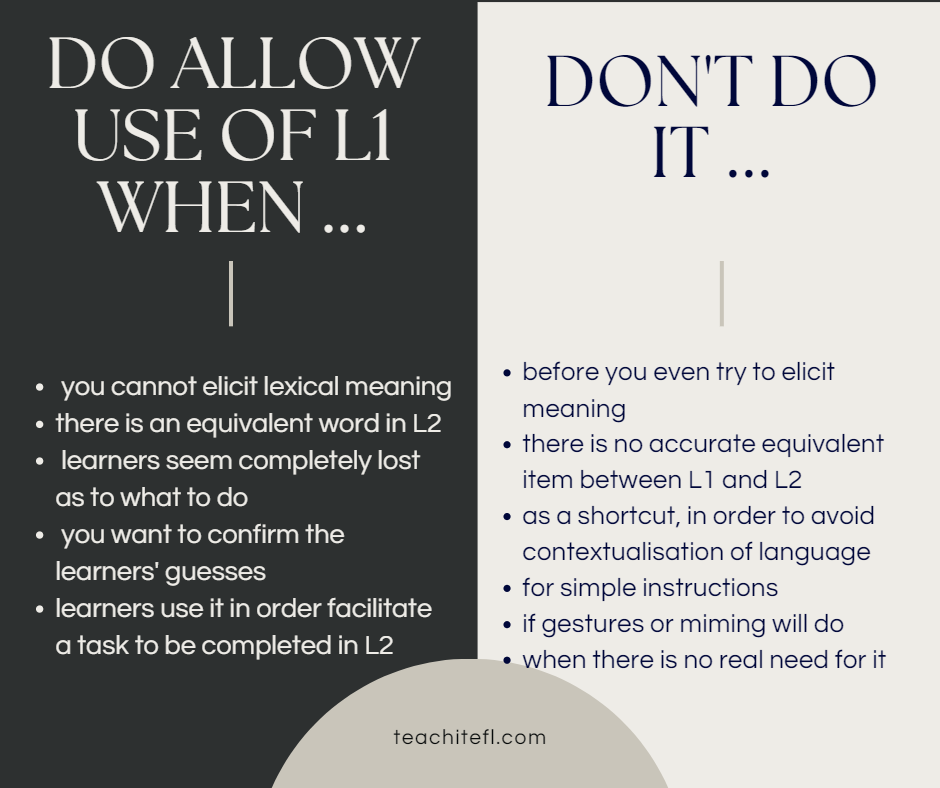
Assuming there is a common L1 to use, there are certain advantages, as long as it is not overused:
When used by the teacher, it can help briefly explain what a word means, when a structure is used or what the learners need to do during an activity. It can save time and confusion, while facilitating the learning process.
When used by the learners during pair/group work, it can help them discuss a point and reach a decision or complete a task. Naturally, not all learners have the linguistic resources to conduct all classroom conversation in English or discuss complex points, especially so at lower levels of instruction. By using L1 learners can:
navigate more complex and interesting topics
quickly resolve a lexical or grammatical difficulty, if L1 does indeed offer an equivalent.
complete tasks more easily and quickly
feel more empowered and motivated as a result
Problems with using L1
(How NOT to use L1 in class)
Most of the problems listed here have to do with overusing the L1 in class or using it incorrectly. In monolingual classes, it is very easy to seek support in the use of your L1, looking for similarities with L2 or even creating ones! Although this is not a bad idea in itself, it is quite often misleading and counter-productive, since such similarities are not the norm. This can lead to a host of problems:
The teacher may oversimplify explanations and then learners may draw the wrong conclusions about the meaning or the use of a language point, resulting in unnecessary transfer errors and hindering the actual learning process. For example, teachers may compare a certain tense in L2 with a tense of similar form in L1. The learners will remember that form since the similarities make it very easy, but they may also assume that the two tenses are used in the same way, so that the meaning they convey is the same in both languages. Needless to say, this is NOT the case with most tenses and it may take some time for learners to unlearn this.
Both teachers and learners may become reliant on L1 for explanations or indeed for most classroom interaction. This does not create good learning habits, as the learners do not explore all the linguistic resources available to them, that is they do not use the L2 even when they easily could. On top of that, they are not exposed to natural communication in L2 if the teacher uses the L1 most of the time.
A word of warning: I have been born pathologically optimistic so I cannot help being cheerful and upbeat. For those of you who find this trait rather annoying, please go no further.
Having all gone through increasingly challenging circumstances over the past couple of years, I like to think that we’ve become more resilient, tolerant, and accepting. Whether you’ve managed to go through 2022 relatively unscathed or whether you’ve had your share of crushed hopes and unfulfilled dreams, the fact remains that you’ve made it through another year and a considerable amount of back-patting is in order.
Since I don’t go for New Year’s Resolutions, what follows is my list of “accomplishments” for 2022, all the reasons why I’m patting myself in the back. If you recognise yourselves at any point along the list, feel free to do the same! It’s not a huge list but includes both professional and personal achievements, so it’s a mixed bag. I‘ll try and keep the self-congratulatory note down 😊
I finally started this blog, after a number of false starts and a ton of hesitation and procrastination – yay!
I continued my training journey, and I can now work as a DELTA tutor; this meant I got to revise, discover and review some very interesting bibliography on learning and teaching languages.
I’ve created a lot of teaching materials last year, for a variety of contexts, including training, of course. I’ve got a lot of ideas about more materials now, and I’ve decided what I want to focus on: storytelling at the heart of learning.
I feel I’ve become more patient, understanding, and supportive as a teacher, and that’s always been a priority for me. Teaching increasingly on-line made me realise how challenging this can be for learners at a deeper level: the online component adding an extra layer of challenge, I could see how much people were struggling and still doing their very best. This in turn made me realise that I needed to step up my game in order to provide the scaffolding needed. I have to say I’m really very proud of my online trainees and the amount of work they put in. You know who you are!
2022 has been the year of quitting certain bad habits, like:
caring for the opinions of people I don’t really know or appreciate
blaming myself for not foreseeing the unforeseeable!!! (If you know, you know)
focusing on everything that could (and did) go wrong and not on what really worked (this one is still a work in progress, but I’m getting better!)
being afraid of putting myself out there: afraid of the criticism, the exposure and the fact that I may discover some unpleasant truths (mainly about myself) along the way. SO WHAT?
This was my achievements list for last year, and putting it down like that helps me see how much I’ve accomplished despite the harsh circumstances we’ve all been facing. If you haven’t made such a list of your own, mentally or in writing, I strongly suggest you should. It is much more grounding and motivating than any New Year’s Resolutions list, which would in fact focus on what you haven’t accomplished yet.
This is what I did with most of my intensive on-line CELTA input sessions.
I hope you find it useful 😊
What you’ll need is
a back-channel communication platform (I used Slack and/or Google Drive)
A live Zoom class as your delivery platform
Rationale:
Since we get a mixture of trainees in terms of language awareness, teaching experience and level of familiarity with EFL / ELT methodology, I’ve always found it prudent to set my expectations bar pretty low, in terms of already acquired course-relevant knowledge. I know most schools do the Pre-Course Task but that is no guarantee that the trainees are familiar with certain grammar concepts or with the terminology used in describing, e.g. listening skills and sub-skills.
Although this is no fault of the trainees themselves, we are still left with a rather awkward situation sometimes. There may be a couple of trainees in the group (or even more than a couple) who have taken the trouble to do some background reading and will have some idea of what teaching language entails, but in many cases the majority of trainees expect to learn all about it on the course.
This leaves us with a couple of choices:
aim the input session overall level at complete beginners (with the danger of being rather simplistic and perhaps disappointing the more advanced of the trainees)
go for the level of complexity and detail that you regard as appropriate for a CELTA course and … hope for the best.
I’ve also tried some middle-ground solutions with mixed results: some trainees found it helpful, others not at all.
I know that it is impossible to please everyone and that the course content cannot be terribly flexible and customisable, but I think I’ve found a way to make this whole process a bit more palatable. Here we go!
Procedure:
A few days before the input session in question, let’s say Pronunciation 1- Individual sounds, I upload some materials on Slack, together with a message explaining what needs to be done with them. For this particular session, these may include an interactive phonemic symbol chart, diagrams or other visuals showing articulator placement for groups of phonemes, some teaching materials with pronunciation exercises and perhaps a presentation with the main points for the session.
Note: The materials I choose can vary depending on the group’s overall level of familiarity with the topic and their tendency to be more or less autonomous in their learning.
These materials are usually accompanied with specific tasks which require the trainees to engage with them and spend some time pondering specific points that usually come up during the session. Again, the tasks vary in terms of depth and autonomy needed to complete them: from simply preparing a list of questions for the tutor to answer during the session to doing certain pronunciation exercises and pinpointing difficulties to evaluating teaching materials.
From this point onwards, I take it for granted that the trainees have studied the materials and that I can start the session with answering trainees’ questions re what they’ve studied. For me, this levels the playing field and helps everyone start from the same point.
During the actual session, I begin with feedback on the tasks completed, answering any questions or going into more detail into certain more obscure points (if needed). Then I try to spend most of the session time with trainees designing a pronunciation task or two focusing on specific sounds. Finally, they can try their tasks on each other and see what worked or not.
And… that’s it! You have now done the half-flip: part of your session was studied beforehand by the trainees and most of the live session was spent either troubleshooting or practising task design!



























 teachITefl