
Hello again and welcome to the second (and last) part on using the learners’ native language (L1) in class.
Having looked at how and why certain learning theories and approaches had “forbidden” the use of L1 in class, we then examined what the situation looks like in today’s multilingual, often on-line classrooms. We are now going to look at whether it is actually a good idea to use L1 in class, when and how.
Benefits of using L1 in class
(How to use L1 in class)
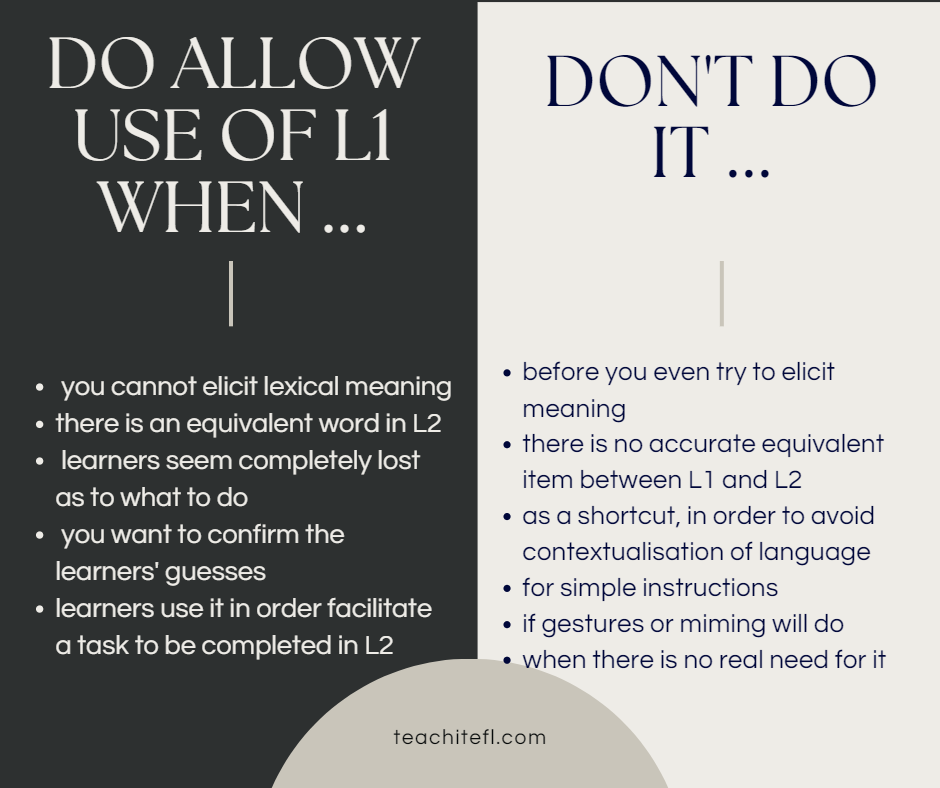
Assuming there is a common L1 to use, there are certain advantages, as long as it is not overused:
- When used by the teacher, it can help briefly explain what a word means, when a structure is used or what the learners need to do during an activity. It can save time and confusion, while facilitating the learning process.
- When used by the learners during pair/group work, it can help them discuss a point and reach a decision or complete a task. Naturally, not all learners have the linguistic resources to conduct all classroom conversation in English or discuss complex points, especially so at lower levels of instruction. By using L1 learners can:
- navigate more complex and interesting topics
- quickly resolve a lexical or grammatical difficulty, if L1 does indeed offer an equivalent.
- complete tasks more easily and quickly
- feel more empowered and motivated as a result
Problems with using L1
(How NOT to use L1 in class)
Most of the problems listed here have to do with overusing the L1 in class or using it incorrectly. In monolingual classes, it is very easy to seek support in the use of your L1, looking for similarities with L2 or even creating ones! Although this is not a bad idea in itself, it is quite often misleading and counter-productive, since such similarities are not the norm. This can lead to a host of problems:
- The teacher may oversimplify explanations and then learners may draw the wrong conclusions about the meaning or the use of a language point, resulting in unnecessary transfer errors and hindering the actual learning process. For example, teachers may compare a certain tense in L2 with a tense of similar form in L1. The learners will remember that form since the similarities make it very easy, but they may also assume that the two tenses are used in the same way, so that the meaning they convey is the same in both languages. Needless to say, this is NOT the case with most tenses and it may take some time for learners to unlearn this.
- Both teachers and learners may become reliant on L1 for explanations or indeed for most classroom interaction. This does not create good learning habits, as the learners do not explore all the linguistic resources available to them, that is they do not use the L2 even when they easily could. On top of that, they are not exposed to natural communication in L2 if the teacher uses the L1 most of the time.
Here’s a useful list of tips:

 teachITefl